The IT/OT Handbook Reader's Guide

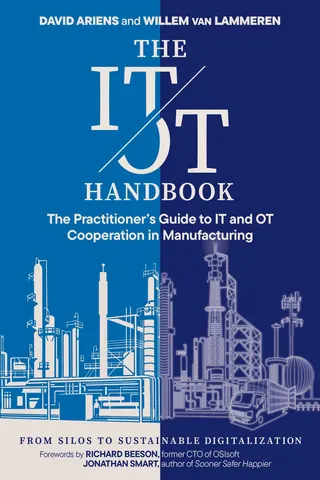
The IT/OT Handbook Reader’s Guide is a companion to David Ariens and Willem van Lammeren’s The IT/OT Handbook: The Practitioner’s Guide to IT and OT Cooperation in Manufacturing. For each chapter it gives you a summary and discussion questions that move from understanding the ideas to applying them. Most chapters also have a hands-on “Try This” exercise, like voting on which of the book’s seven cooperation patterns describes your organization, or sketching an ISA-95 asset hierarchy for one of your own processes.

The guide is built for book clubs, cross-functional IT/OT leadership teams, training and onboarding programs, and individual readers. A reading plan by role shows practitioners, leaders, and consultants where to start. Suggested session formats let a group cover the book in three meetings or nine. A quick reference to key concepts, from CIA vs. SIAC to the Unified Namespace, helps anyone who joins the conversation partway through.

Formats
epub · pdf
License
Creative Commons BY-NC-SA

About the authors

2 authors
David AriensCo-founder, The IT/OT Insider

Affiliation as of 2026-09-07

David Ariens entered the world of large chemical plants in 2010 as a freshly graduated mathematical engineer, stepping into a newly invented position: data scientist at BASF, the multinational chemical giant. He arrived at a pivotal moment—that same year, the industrial world was shaken by Stuxnet, the first computer virus to target an industrial plant. Designed to damage an Iranian uranium enrichment facility previously considered impregnable, Stuxnet sent a shock wave through the industry and marked the tipping point when IT made its way into the heart of manufacturing companies. Building the bridge between the corporate IT world and the operational OT world became Ariens's profession. He traveled the globe, guiding companies through this complex and fascinating change. In 2012 he introduced BASF's global Industrial Cyber Security program and was put in charge of overseeing the EMEA region. By 2018 he had become responsible for the industrial digitalization teams at one of the world's largest chemical production sites—the BASF facility in Antwerp—while also taking functional leadership of the EMEA Industry 4.0 team. Between 2022 and 2025 Ariens was the manager of Analytics For Industry, a company focused on accelerating IT/OT convergence. He serves as an advisory board member for the software startup Timeseer.AI and teaches courses on industrial digital transformation. He is committed to becoming the go-to resource for leaders navigating this paradigm shift.

Everything by David Ariens →

Willem van LammerenPM Industrial AI, Syensqo

Affiliation as of 2026-09-01

Willem van Lammeren trained as a chemical engineer, but his passion for IT made digitalization in manufacturing the logical place to build his career. In 2006 he joined Barry Callebaut as part of a small team launching a new frozen pastry production facility in southern Spain. He then moved to AB InBev, the renowned Belgian brewery, where he coordinated and facilitated the implementation of a management excellence program across Western Europe before joining BASF. At BASF, van Lammeren was one of the few people in IT who had actually worked in production, which positioned him to explore the emerging domain between IT and operations. He experimented with new approaches in fast, iterative fashion while also experiencing classical IT with detailed requirements and rigorous processes. He eventually moved closer to production, collaborating with David Ariens at the Antwerp site. After several years automating supply chain and lab solutions, he stepped into middle management, where many of their shared ideas took shape. Today van Lammeren serves as tech lead for Industrial IT at Syensqo, where he leads the project to build the company's operational data lake. The idea for this book originated on an afternoon in his garden, when he called Ariens and suggested they stop talking about these ideas over coffee and start writing them down.

Everything by Willem van Lammeren →